 This documentation is released under the Creative Commons license
DT router
This router module should be attached to the network layer of the node that participates in MANET routing. It contains a SaorsManeger which instantiates the requested routing protocol. You should configure the routing protcol to be the same across the whole network. Place the following in your INI file:
**dtrouting.saorsmanager.routingProtocol="DT-DYMO"
along with parameters for the choosen routing algorithm. At the moment the following DT routing algorithms are supported: -> SAMPhO (Socially-Aware Multi-Phase Opportunistic routing) -> DT-DYMO (Delay-Toleranent DYMO) -> SimBetTS (The similar to DT-DYMO bit using the SimBetTS utilities) -> EP-DYMO (Epidemic DYMO) -> R-DYMO (Random DYMO)
NOTE:
See also: SaorsManager, SAORSBase, SAMPhO, DTDYMO, EPDYMO, RDYMO
Author:: Nikolaos Vastardis
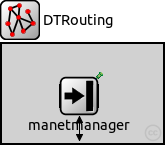
The following diagram shows usage relationships between types. Unresolved types are missing from the diagram.
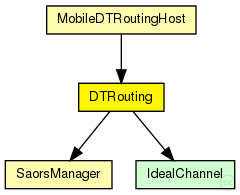
The following diagram shows inheritance relationships for this type. Unresolved types are missing from the diagram.

| Name | Type | Description |
|---|---|---|
| MobileDTRoutingHost | compound module |
Models a mobile host with a wireless (802.11g) card in ad-hoc mode. This model contains the new IEEE 802.11 implementation, Ieee80211gNicAdhoc, and IP, TCP and UDP protocols. The mobility model can be dynamically specified with the mobilityType parameter.Supports opportunistic routing protocols by setting the **dtrouting.saorsmanager.routingProtocol parameter. |
| Name | Value | Description |
|---|---|---|
| display | bgb=161,99;i=block/network2 |
| Name | Direction | Size | Description |
|---|---|---|---|
| from_ip | input | ||
| to_ip | output |
| Name | Type | Default value | Description |
|---|---|---|---|
| manetmanager.routingProtocol | string | ||
| manetmanager.manetPurgeRoutingTables | bool | true | |
| manetmanager.AUTOASSIGN_ADDRESS | bool | false | |
| manetmanager.AUTOASSIGN_ADDRESS_BASE | string | "10.0.0.0" |
//
// DT router
//
// This router module should be attached to the network layer of the node that
// participates in MANET routing. It contains a SaorsManeger which instantiates the
// requested routing protocol. You should configure the routing protcol to be the same
// across the whole network. Place the following in your INI file:
//
// **dtrouting.saorsmanager.routingProtocol="DT-DYMO"
//
// along with parameters for the choosen routing algorithm.
// At the moment the following DT routing algorithms are supported:
// -> SAMPhO (Socially-Aware Multi-Phase Opportunistic routing)
// -> DT-DYMO (Delay-Toleranent DYMO)
// -> SimBetTS (The similar to DT-DYMO bit using the SimBetTS utilities)
// -> EP-DYMO (Epidemic DYMO)
// -> R-DYMO  (Random DYMO)
//
// NOTE:
//  - A node participating in DT routing must have a single network interface with "wlan"
//    in its name somewhere e.g: wlan0 or localwlan
//
// @see SaorsManager, SAORSBase, SAMPhO, DTDYMO, EPDYMO, RDYMO
//
// @author: Nikolaos Vastardis
//
module DTRouting
{
    parameters:
        @display("bgb=161,99;i=block/network2");
    gates:
        input from_ip;
        output to_ip;
    submodules:
        // the name of manet routing manager module must be "manetmanager", the routing protocols is ManetRouting.ned
        manetmanager: SaorsManager {
            parameters:
                // Manager parameters
                // eliminate in the routing table all the initial reference to wlan interfaces
                manetActive = true;
                // manetPurgeRoutingTables = true;
                @display("p=77,52;b=40,24;i=block/arrival");
        }
    connections allowunconnected:
        manetmanager.from_ip <-- from_ip;
        manetmanager.to_ip --> to_ip;
}
This documentation is released under the Creative Commons license